Our RV Solar Upgrade: How the Pieces Fit Together
◆
Our RV Solar Upgrade: How the Pieces Fit Together
Our RV came with one solar panel to help recharge the battery. There was no inverter, so that panel wasn’t going to let us unplug from campground power and use the microwave or watch TV.
We wanted a system that would let us use the RV much the way we normally do, even without hookups. That meant figuring out how much power we use, how to replenish it, and where all the equipment would fit.
That last part gets a vote whether I like it or not.
We’ve installed part of the system and are planning the expansion. The diagram shows where we’re headed.
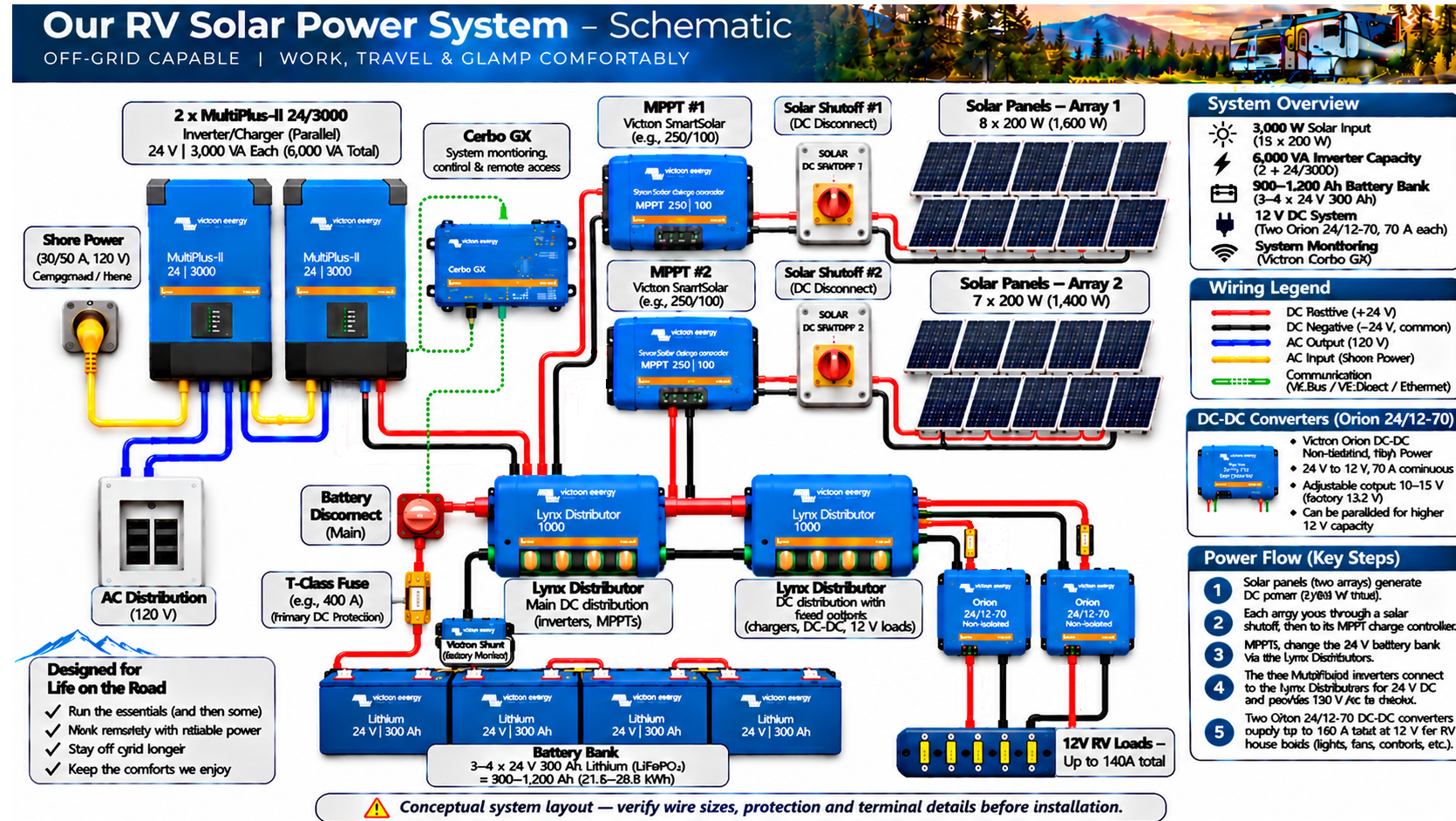
Our planned system layout. Some components are already installed; the additional inverter, solar panels, charge controller, and batteries are part of the expansion. This is a conceptual overview, not an installation wiring guide.
Following the power
Start at the solar panels. Their power goes to an MPPT solar charge controller, which regulates the solar output for charging the batteries. From there, it connects to the DC system through a Lynx Distributor.
The Lynx is the distribution point connecting the batteries and the other DC components. Think of it as the junction where the different parts of the system come together.
From that battery system, we need to supply two kinds of power. The RV’s 12V equipment gets its power through two DC-DC converters that reduce our battery system’s 24V to 12V. The inverters turn battery power into the 120V AC power used by the outlets, microwave, TV, and other household equipment.
That’s the part we didn’t have with the original setup: a way to use stored battery power for those everyday conveniences.
Why this much solar—and why 24 volts?
The plan calls for fifteen 200W panels, for 3,000W of rated solar capacity. The goal is to replenish the batteries while we’re using the RV off-grid. Actual production will depend on the conditions, so the number on the panels won’t tell the whole story.
We're planning two MPPT controllers to divide the solar capacity between them. We currently have one installed; the second is part of the expansion.
The decision to use a 24V battery system came down largely to wiring and cost. For the same amount of power, a higher-voltage system draws less current. That can reduce the cable size needed compared with a 12V setup, depending on the circuit and cable run.
We still need 12V for the house equipment, which is why the converters are part of the design.
How much battery storage will fit?
We started with our estimated daily use, including everyday appliances such as the TV and microwave. Looking more closely at our power needs also led me to add a second inverter to the plan, so the load can be shared between the two.
Battery capacity has another constraint: physical space.We have one 24V battery installed now. We're hoping to fit four in the finished system, but we still need to confirm the available space before settling on the final count. We can calculate what I’d like to have. The compartment will determine what we can actually put in it.
We also haven’t tested the expanded system yet, so I’m not ready to say which appliances we’ll comfortably run together or how long the batteries will last. Those answers need some actual use behind them.
What happens at a campground?
When we plug into campground power, shore power can supply the RV and the inverter/charger can recharge the batteries. When we unplug, the inverter system supplies AC power from the batteries again.
That gives us a way to use both hookups and battery power as we travel. Solar adds another way to recharge when we’re away from the pedestal.
The less glamorous components matter, too. The shunt tracks current going into and out of the battery bank to help estimate the charge remaining. Fuses protect against overcurrent, and the battery disconnect provides a way to isolate the battery bank. The Cerbo GX is the monitoring hub in the design, bringing information from connected equipment together so we can see what the system is doing.
Where the project stands
Right now, we have one inverter, one 24V battery, one MPPT controller, both Lynx Distributors, and both 24-to-12V converters installed.
The next stage is the additional inverter, the expanded solar array and second controller, and more batteries once I’ve confirmed the fit.
We're most interested in seeing how the additional battery storage performs during a normal day in the RV. We’ve done the estimating. Once the expansion is in, we’ll be able to compare that with what we actually use.
First, though, we need to find out whether battery number four gets a parking spot.